Thursday, March 19, 2015

Thursday, January 8, 2015
Sunday, December 14, 2014
Amazon to launch UK based game download store in October
Playing US catchup

Amazon UK is set to get its own digital game download store, bringing the shopping service inline with the US.
The Americans have been enjoying downloadable games since 2009, with quality titles being added in November last year. Amazon.com has its ownspecial download section, stocked full of a series number of titles that you can pull straight from the cloud to your hard drive.
MCV is reporting that the service has seen severe delays, originally pegged for an April launch. Things are currently in testing phase, with everything on track for an Autumn release.
"Amazon can use its retail muscle to draw attention to PC digital downloads and even upset the established order, where Valve sits at the head of the table." a rival retailer told MCV.
Steam currently retains the disc free download crown. Amazon however, the worlds biggest online shopping site, could pose a serious threat.
Personally we welcome the digital download concept, provided you have plenty of bandwidth to play with, otherwise those desperate to play may find days of waiting before downloads complete.
Digital downloads? Or discs your thing?
Tuesday, October 14, 2014
Will Amazon's Unit Growth Bottom Out in Q2?
There's not a whole lot that Wall Street dislikes right now about Amazon, which is heading into its second-quarter earnings report today after markets close. Investors have pushed the online retailer's stock price to record heights in recent weeks - more than $309 a share, and a market cap of $140 billion at one point - before backing off slightly to see Amazon close out Wednesday's after-hours trading at about $300 a share.

Despite the good vibes, there are problem areas. The company's year-over-year growth of units sold has been decelerating, for example, which could be worrisome if it continues.
J.P. Morgan's Doug Anmuth wrote in a research note that he is expecting some stabilization in the decelerating trend, but noted that, "we ... believe sub-30% would be concerning to investors." The launch of the Kindle in some giant new markets, such as India and China, could put the trend of deceleration to an end in the second half of the year.
Wall Street will also be keeping a close eye on the company's international business, especially after eBay cited macroeconomic softness in Korea and parts of Europe when it reported earnings last week.
Investors will also likely look for some commentary on the same-day and next-day AmazonFresh grocery delivery business, which, after five-plus years of experimentation solely in Seattle, recently started serving the Los Angeles area. If Amazon can figure out how to at least break even on that resource-intensive business, it will likely then load up the delivery vehicles with higher-margin, higher-cost products.
But it will be a costly build-out, and could impact margins negatively in the short term. Similarly, fulfillment-center expansion and price cuts on AWS offerings could also drag down margins.
Amazon is forecasting revenue of $14.5 billion to $16.2 billion, with analysts expecting the company to register earnings per share of four cents to six cents on $15.7 billion in revenue.
Sunday, October 5, 2014
Amazon's Q2 Is a Miss

JOE KLAMAR/AFP/GettyImages
First quick look at Amazon's earnings numbers, and it's a miss.
The online retail giant posted a loss, at an EPS of minus two cents on revenue of $15.7 billion.
Though Amazon's net sales rose 22 percent compared to the year-ago quarter, it's a disappointing miss against analysts' expectations that the company would post earnings per share of four cents to six cents on $15.74 billion in revenue.
"This past quarter, our top 10 selling items worldwide were all digital products - Kindles, Kindle Fire HDs, accessories and digital content," CEO Jeff Bezos said in a canned statement. (Of course, with no actual sales numbers on the amount of Kindle products sold - as always.)
Not a ton of color in this release as to why Amazon missed, nor are there any notes on AmazonFresh, the company's experimental grocery delivery service. Hopefully, CFO Tom Szkutak will address these points on the conference call with analysts coming up shortly.
Shares of Amazon were trading off around two percent on the news, at around $297 per share.
Sunday, September 21, 2014
New Kindle Paperwhite Is a Snappier, More Capable E-Reader
There's a new Kindle in town: The Kindle Paperwhite. This latest product in Amazon's line of basic monochrome e-readers has some welcome improvements over last year's Paperwhite, including a faster processor and a nicer screen.
But since it's not a blow-your-mind upgrade, Kindle lovers might be wondering whether it's worth an upgrade. And e-reader newbies may wonder what the difference is between this one - which starts at $119 - and the $69 entry-level Kindle.
I've been using the new Kindle Paperwhite for the past week, reading mostly media theory and economics books, which means I use it for less than an hour a night before I fall asleep. My conclusion is that it's probably not a must-have for people who are perfectly happy with their 2012 Paperwhite, but it is very tempting. Overall, the new Paperwhite is an excellent product.
It's a little bit snappier than the 2012 version. The front-lit E-ink screen doesn't have the "shadows" that plagued some of last year's Paperwhites, including the one I have. And I like the new features that help you recover your place more quickly, as well as Vocabulary Builder, which creates flash cards of the word you look up using the Web-based dictionary.
In deciding whether to purchase this e-reader for yourself it might help to first understand the Amazon Kindle product line.
There are currently two different Kindle e-readers being sold: The "regular" Kindle and this Kindle Paperwhite, which replaces last year's model.
Then there are variations within those two products: Wi-Fi-only models, those with both Wi-Fi and 3G, those with ads, and those without. Both have monochrome E-ink screens but the Paperwhite has a glow-y screen so you don't have to shine a light on it to read in the dark.
Also, the regular Kindle has buttons, not a touchscreen; and it's significantly cheaper, starting at $69. (These shouldn't be confused with Amazon's separate Kindle Fire line, which consists of full-color tablets running apps.)
The new Kindle Paperwhite costs $119 for a Wi-Fi-only version with "special offers," which basically means that Amazon runs ads for books across the lock screen. Then the price jumps up to $189 for a Wi-Fi and 3G Paperwhite with special offers. Strip the special offers away for an ad-free e-reader and both of those models go up in price by $20.
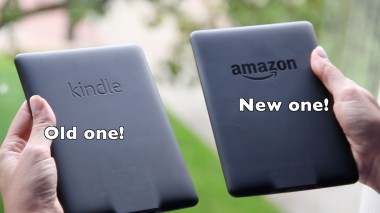
The new Paperwhite measures the same as the previous one - 6.7 by 4.6 by .36 inches - and has a six-inch touchscreen display. It weighs 7.3 ounces, meaning that it's less than an ounce lighter than the 2012 Paperwhite, and when I held one in each hand, I really couldn't tell the difference. It has a smooth, rubberized coating, and feels durable.

On the left is the 2012 version of the Paperwhite. On the right, the new model.
It comes with two gigabytes of internal storage, storing around 1,000 books. At the bottom of the Paperwhite there is a power button, a status light and a micro-USB port for charging. There are no other buttons on the device.
When you fire up the Kindle, you see a row of options at the top of the screen, including home, back, lighting adjustment, settings and a shopping cart that takes you to the Amazon store.
This is, of course, so you can buy e-books on Amazon.com. (The Kindle app on iPad, which I also use regularly, doesn't have a purchasing option.) Amazon has around two million e-books available for download on Kindle, including 400,000 that are exclusive to the Kindle store. Users can also borrow a fraction of those e-books, provided that you're an Amazon Prime subscriber.
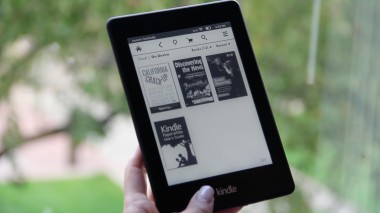
In my experience, three out of roughly a dozen books I've searched for in the past week weren't available on Amazon.com as a Kindle download.
Once I started reading I could see the difference between last year's version of the Paperwhite and this new one. My old Paperwhite has a strange "shadow" at the bottom of the display and in general can have a sort of uneven look. The new one looks brighter, the contrast of black and white is greater, and the best part - there are no shadows on the screen.
The new Paperwhite also has a faster processor. I noticed its speediness more when toggling through the icons at the top of the screen - tapping the home button, searching, going into settings - because everything just felt more responsive. I didn't notice it quite as much with page turns. If it is faster, it might be fractions of a second faster. Books also downloaded very quickly.
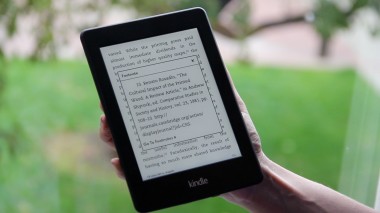
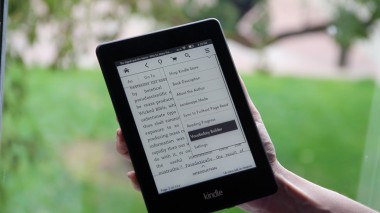
There are a handful of new or improved features that Amazon is boasting about with this Paperwhite, but I'll focus on three key ones: Page Flip, In-Line Footnotes and Vocabulary Builder.
Page Flip lets you skip around without losing your place. In-Line Footnotes lets you view a footnote from the page you're on in a pop-up window, instead of being catapulted to another part of the book. In my experience, In-Line Footnotes worked with some books, but not all. Vocabulary Builder, which appears in a drop-down menu from the settings tab, shows you flash cards for all the words you've searched for while reaching.
The good news about the new Paperwhite's battery is that it matches the battery of the old Paperwhite, even while running on a more powerful processor. The battery will probably outlast Jeff Bezos's 10,000-year clock. Okay, not really, but Amazon said it can last up to two months with Wi-Fi turned off. After five nights of using the Kindle Paperwhite with Wi-Fi turned on, my battery had only dwindled to approximately 70 percent.
The bad news is that Amazon still isn't throwing a power adapter for wall outlets into the box, which means you could spend $15 extra on that.
A few more downsides: The Paperwhite doesn't have a headphone jack, and it doesn't support audio books through Audible. The "experimental browser" still feels like an experiment.
Also, and this is a small thing, but I really like that notes are auto-corrected when you're using the Kindle app for iPad. Conversely, on the Kindle e-reading devices, text isn't auto-corrected, which means I'm fat-fingering all sort of words that probably won't make sense to me later on.
Downsides aside, the new Kindle Paperwhite is a welcome improvement in the Kindle line.
Friday, September 19, 2014
Kindle Fire HDX: A More Helpful Tablet
What if you could summon a tech-support person to pop up in seconds in a live video on your digital device? And what if that person could draw on the screen or even take over the device to solve a problem?
Well, starting Oct. 18, you can do just that with the latest in Amazon's Kindle Fire tablet line, the Kindle Fire HDX. This help system, called the Mayday button, is the most unusual feature of what is otherwise a mainly evolutionary new model of the company's color tablets.
A better help system isn't exactly the prime reason to buy a new tablet. After all, tablets are supposed to be simple and easy to figure out. But Mayday is consistent with Amazon's long, well-earned reputation for customer support.

X-Ray for Music shows lyrics synchronized to the song playing on the Kindle Fire HDX.
I've been testing the Fire HDX, and it's a good, basic color tablet. This latest model, which starts at $229 for the 7-inch-screen version I used, is a definite improvement on last year's Fire HD, which started at $199 for the 7-inch version. (There's also a costlier, larger HDX version, with an 8.9-inch screen.)
Like earlier Fire models, it's best thought of as a hardware gateway to buying digital content from Amazon. The base model blasts ads at you from the home screen, but you can buy one without ads for $15 more.
However, the 7-inch Fire HDX, like its predecessor, still isn't as versatile or full-featured as rival tablets, like Apple's iPad mini or Google's Nexus 7. It offers only a fraction of the third-party apps available from the Apple or Google app stores. Among the missing are such popular offerings as Instagram, Dropbox, Google Maps, YouTube and Netflix (Amazon says a Netflix app is coming soon).
Unlike the mini or the Nexus, the 7-inch Fire HDX lacks a rear camera, so you can't easily show your surroundings to others during a video chat (the bigger model has a rear camera).
And the HDX has no equivalent to its rivals' voice-controlled, artificial intelligence features, Apple's Siri and Google Now.
And the Fire HDX turned in a so-so battery life of 7 hours that, while better than the 6 hours of the latest Nexus 7, paled before the iPad mini's 10 hours and 27 minutes. (I used my standard test where I set the screen to 75 percent brightness, keep the Wi-Fi on and play videos stored on the tablet until the battery dies.)
So, what makes the new Kindle HDX better than the last model? Well, it has a gorgeous, high-resolution screen that displays 323 pixels per inch, the same as the latest $229 Nexus 7, but much higher than the $329 iPad mini's 163 ppi (though the mini's screen is significantly larger, at 7.9 inches). The screen also was a bit more readable in sunlight than the iPad's. The Fire HDX has a faster processor that has eliminated the latency I encountered when testing last year's model.
The Fire HDX has a new operating system and some cool new features. The home screen still has a carousel to show recently used apps, songs, books and videos, but below that there's now a standard grid of icons for favorite apps and you can hide the carousel if you find it distracting. There's also a new sidebar for quickly switching among running apps. This appears when you swipe from the edge of the screen.
Perhaps my favorite new feature is called X-Ray for Music, which shows synchronized lyrics to the song you're playing. So far, it's only available on "tens of thousands" of Amazon's 25 million songs, starting with the newest and most popular. But I found scattered cases in songs going back to the 1970s and enjoyed using it.
The Fire HDX is slimmer and lighter than last year's model, and has tapered edges. But there's a downside to this design. Because the tapered edges are narrow, the volume and power buttons have been moved to the back of the tablet. I found them clumsy and slow to use.
Like its predecessors, the Fire HDX is technically an Android tablet that buries Android so it's invisible. The HDX lacks any hint of Google's Android interface, the standard Google apps that come on most Android devices and the standard Android app store, Google Play. Instead it uses an Amazon operating system now called Fire OS 3.0.
Amazon has its own app store for the Fire HDX and it contains 85,000 apps, compared with roughly a million each in the Google and Apple app stores.
The Mayday help button worked mostly as advertised, though I got little useful help, partly because Amazon is training a large number of support people and few have much experience yet with the new HDX.
When you click the Mayday button, which appears in a settings bar that swipes down from the top of the screen, a small, movable video window pops up. You can see the support person, but he or she can only hear you. To better explain things, the person can draw on your screen. And if you allow it, he or she can take over the Fire to perform tasks.
The support people appeared in 10 seconds or less and were unfailingly friendly. But they often just went poking around the device, looking for a menu item or icon that would accomplish what I couldn't figure out. In two cases, they put me on pause, to do some quick research. Amazon says their knowledge will grow as they get more familiar with the new hardware and software.
In one case, a Mayday agent I had previously talked with followed up on an earlier question concerning how to get an app that wasn't in the Amazon app store for the HDX. She sent me an email explaining how to do a 10-step workaround.
Mayday isn't entirely private. You have to give agents your name, email and address, the call is recorded and customer-service management can see reports on individual calls. But overall, it's a great idea.
If you mainly want a tablet for consuming content and regularly use Amazon content, the new Kindle Fire HDX is a good deal.
Email Walt at mossberg@wsj.com.
Thursday, September 18, 2014
How Jeff Bezos Crushed Diapers.com So Amazon Could Buy Diapers.com

A day after the New York Times dropped an excerpt of a juicy upcoming book about Twitter, Bloomberg Businessweek has published an excerpt of journalist Brad Stone's book about Amazon and CEO Jeff Bezos, due out on Oct. 15.
While the book, "The Everything Store: Jeff Bezos and the Age of Amazon," may not match the stories of treachery from Nick Bilton's Twitter tale, Stone's account is heavy on stories about Bezos's ruthlessness.
One example: The story of how Amazon.com came to acquire one of its hotshot competitors, Quidsi, the parent company of Diapers.com.
Stone explains how Amazon has a secretive unit - dubbed Competitive Intelligence - responsible for ordering large quantities of goods from competitors to analyze their businesses. This division eventually became aware of Diapers.com and its parent company Quidsi, and dispatched M&A chief Jeff Blackburn to initiate acquisition discussions.
Quidsi's founders originally rebuffed acquisition offers from Amazon. So Bezos's Amazon sent them a message, Stone explains:
"Soon after, Quidsi noticed Amazon dropping prices up to 30 percent on diapers and other baby products," Stone writes. "As an experiment, Quidsi executives manipulated their prices and then watched as Amazon's website changed its prices accordingly. Amazon's pricing bots - software that carefully monitors other companies' prices and adjusts Amazon's to matc - were tracking Diapers.com."
Diapers.com revenue growth eventually slowed under Amazon's pricing pressure, and the founders engaged in acquisition talks, agreeing to a $540 million buyout.
As Stone tells it, Walmart eventually made Quidsi a better offer of $600 million, but it was too late by then.
"The Quidsi executives stuck with Amazon, largely out of fear," Stone writes.
The excerpt also discusses how the most-feared emails within Amazon are forwarded customer complaints from Bezos, accompanied by a single character: A question mark.
Stone recounts the story of how one such complaint led Bezos to almost shut down Amazon's entire email marketing division, responsible for hundreds of millions of dollars of revenue.
Because of customer feedback emails, Bezos had discovered that Amazon shoppers who browsed for personal lubricants were receiving personalized follow-up emails about these products.
Bezos threatened to shut down the entire email marketing operation, and then had a team work for months on plans to replace all of the marketing emails that Amazon sent out with one weekly digest email.
That plan was eventually scrapped, but a different kind of compromise was reached:
"E-mail marketing would be terminated for certain categories such as health and personal care," Stone writes. "The company also decided to build a central filtering tool to ensure that category managers could no longer promote sensitive products, so matters of etiquette were not subject to personal taste."
Bezos himself was not interviewed for the book, Stone writes. But he allowed the participation of hundreds of former and current Amazon employees.
Perhaps the most compelling piece of the excerpt centers not on Amazon, but on Bezos's family backstory. Born to a 17-year-old mother and a teenage father, Bezos eventually grew up with his mother and her second husband, Miguel Bezos.
Along the way, according to the excerpt, Bezos's biological father, Ted Jorgensen, lost contact with the family, having not seen his son Jeff since he was 3. Decades later, while researching the book, Stone dropped in unannounced on Jorgensen at the bike shop he owns in Glendale, Ariz.
Jorgensen had no idea that his only biological son had become one of the most successful businessmen in the world. And his four stepsons had no idea that their stepfather had a child of his own.
But when Jorgensen finally came clean to his stepsons about his full backstory, and one of them researched who Jorgensen's son had become, one startling similarity between Jorgensen and Bezos stood out.
"He has Ted's laugh!" the stepson told Stone. "It's almost exact."
Friday, August 29, 2014
Yet Another Way to Get a Super-Cheap Web TV Box

What's that? You say you're intrigued by the notion of a Web TV box, but $35 for a Google Chromecast is too rich for your blood?
Here you go - if you live in the U.K.: Satellite TV service BSkyB has rolled out a Web TV box for 9.99.
That works out to about $15, and what that gets you is essentially a rebranded Roku HD box - BSkyB invested in Roku last year, and once again this spring - tailored to support BSkyB's Now TV streaming subscription service. That also means that the box won't support BSkyB rivals Netflix and Amazon/Lovefilm.
You can see more specs and details here, but the big picture is that this shows yet another approach to distributing Web-to-TV hardware: Rather than have consumers buy the gadgets directly from the manufacturer, a programmer/distributor sells the box and subsidizes the cost.
Expect to see more of this in the future. For starters, note that Roku's other investors include 21st Century Fox, Dish Network and Hearst, which owns both TV stations and stakes in TV networks including ESPN.
Meanwhile, Apple is in talks with Time Warner Cable about an Apple TV tie-up; for now, that deal doesn't call for the cable operator to sell Apple's boxes, but you could certainly imagine a pact where it does.
And remember that Amazon, which tried to buy Roku last year, has its own TV box in the works, which will be optimized for Amazon's own video offerings.
Wednesday, July 30, 2014
Why Wall Street Should Care About Marketing Data

Image copyright leungchopan
Today's CMOs are making major investments to reach their target audiences across dozens of touchpoints - on their own websites, through search, display advertising and email, and increasingly on social channels and mobile devices.
The problem is, most of the technology platforms marketers are using to accomplish this don't talk to each other.
What's more, many of the groups within the organization running these programs are just as siloed. This means that the things marketers learn about customers in one channel often don't translate into sound strategy decisions for other channels.
I'll give you an example. Today, if someone clicks on a display ad, reaches a landing page and fills out a form, the CRM or marketing automation system can capture that lead and track that it came from display advertising. What marketers can't yet do is take advantage of the information exchange in the opposite direction. What if they could use the rich information stored in the CRM system - such as how far along a prospect is in the sales pipeline - to make the display ad creative and messaging more relevant?
Marketing executives know they need to get their systems and people to talk to each other. In fact, a new study by Accenture Interactive, "Turbulence for the CMO," reveals that 70 percent of top CMOs think they have five years to fundamentally overhaul their companies' corporate marketing operating model to achieve competitive success. Big marketing technology companies know this too, and it is why companies like Salesforce, Oracle and Google are duking it out to own the customer data and CRM system. They want to be at the center of the value created by unlocking this marketing data and getting at an integrated view of a prospect or customer.
Think about how powerful it would be to serve up personalized Web content based on the ads someone has previously been exposed to, events they've attended, or when they've most recently engaged with a sales rep, or, to easily target email or display ads to just those people who engaged with a social campaign.
One company in particular has built a business around this very concept: Amazon. Amazon.com might very well be the most sophisticated marketer on the planet today, and if you spend a few minutes on their site looking at products, you'll notice that the follow-up emails you get, the next experience you have on the site and even the display ads you see will all be synched to your product searches and prior browsing history - all to help you convert. Amazon is far ahead of the pack, with very few keeping pace today.
As companies get better at integrating their marketing systems to more fully understand the customer journey - from first exposure to the brand to the last program that drove the sale, and every touchpoint in between - every marketing dollar spent becomes extremely efficient.
And it's a lot of dollars at stake. According to research by Outsell, B2B marketers alone will increase their advertising and marketing digital spend by almost 11 percent to $65.9B in 2013. Imagine the bottom-line impact when the performance of these investments improves by five percent or 10 percent - just by having the left hand talk to the right.
As companies use data to optimize their digital tactics - whether it's through better targeting, reaching people where they are consuming media or tying together all the pieces of the marketing funnel - they'll inevitably achieve a step-function in efficiency in terms of deploying marketing spend for impact. They can then cycle the additional revenue back into marketing, or R&D, or more salespeople.
And this is where Wall Street comes in. Wall Street should care about marketing data because companies that do the best job of tying together and leveraging marketing data will ultimately win and create outsized shareholder value.
So how can you tell if a company has a data-savvy CMO? Look for clear evidence of marketing integration.
It's actually pretty amazing how many large companies have yet to integrate their marketing tactics. Investors should be looking to see, for example, if a company has a Super Bowl TV spot that they're also using search ads and display ads to reinforce the Super Bowl message. The company should also be previewing the ad online to test customer response and drive viral awareness before the TV ad ever launches. Companies that only have a single spot and don't back it up (and there are lots of them!) aren't communicating effectively across the organization nor are they maximizing returns on invested capital. This is likely a good indicator that other programs are not well integrated either.
Another great way to test for marketing integration is simply the relevance of the ads you're seeing. If they are relevant, and improving over time, the company is likely making the right investments in marketing technology to be ready for the next 10 years of growth. If you still get the same untargeted direct mail piece that you throw away every week, there's cause to be concerned.
There are a lot of reasons to be bullish about the economy and the stock market over the next five to 10 years. Look no further than the innovation beginning to hit the CMO's office to help decide if you agree, and if so, how to find leaders to invest in.
Russell Glass, CEO of Bizo, is a serial technology entrepreneur, having founded or held senior positions at four venture-backed technology companies. Prior to Bizo, Russ led the marketing and product management teams at ZoomInfo, a business information search engine, where he sharpened his B2B marketing skill set and developed his love for business data.
Monday, July 21, 2014
Amazon Cloud Drive Photos App Expands To Support Video Upload & Playback On Android

Amazon Cloud Drive Photos, the photo-uploading utility that helps move photos from a mobile device into Amazon's online storage, may have to change its name. Now, the tool doesn't just support photo uploads, it supports videos, as well. Videos can be manually uploaded one by one, or users can opt to have videos auto-save from their devices directly into Amazon's cloud.
This automatic upload option was already available for photos through an update out at the beginning of the year, but videos within Cloud Drive Photos had not yet been supported, whether manually or through the auto-upload feature within the application.
Amazon says that videos are restricted to 2 GB in size or 20 minutes in length, whether they're being uploaded or downloaded from the Cloud Drive service - that's slightly longer than YouTube's default setting ahead of account verification. This is fine for the majority of users' personal videos, of activities, pets, kids or events, for example, recorded on their mobile devices.
After the files are in Amazon's cloud, the video can be played back to any device, including, of course, the Kindle Fire and other Android tablets. According to a post on Amazon's Web Services blog about the technical underpinnings to the new feature, Amazon's Elastic Transcoder service was used, which supports over 20 file formats and 40 video codecs. The team says its goal was to have videos transcoded within 15 minutes after uploading, but ended up achieving videos that are often ready within a minute or two. They also went ahead and processed all the videos stored in Amazon users' Cloud Drive libraries ahead of launch.
Though the company offers a version of its Amazon Cloud Drive Photos app on iOS devices, too, only the Android version has received the video support at this time. That makes sense because not only is the Kindle and Android-based tablet, and therefore Amazon's priority, the Android app was also the first to launch, back in November 2012.
The iOS version didn't arrive until this May, and it serves as a viable alternative to Apple's own iCloud sync and storage service, with reasonable pricing of 5 GB for free, then $10/year for 20 GB, $25/year for 50 GB and so on, all the way up to 1,000 GB for $500/year. Keep in mind that the storage goes up so high not because users need so much space for photos (and now videos, too), but because Amazon Cloud Drive is meant to serve as a competitor to Google Drive or Dropbox, with support for a variety of file types, including office documents and music, which can also be streamed back through Amazon Cloud Player.
In other words, this isn't the first time users could upload videos to Amazon's cloud. This is just making it possible to do so within the Cloud Drive Photos application.
The updated Cloud Drive app is available now on Google Play and Amazon's Appstore.
Friday, July 4, 2014
Amazon's Q2 Disappoints, Sales Up 22 Percent To $15.7B, Net Loss Of $7M

Amazon just reported second-quarter earnings, with sales increasing 22 percent to $15.7 billion in the second quarter, compared with $12.83 billion in second quarter 2012. Net loss was $7 million in the second quarter, or $0.02 per diluted share, compared with net income of $7 million, or $0.01 per diluted share, in second quarter 2012. Analysts expected $15.74 billion in revenue, and $0.05 on earnings per share.
Operating income decreased 26 percent to $79 million in the second quarter, compared with $107 million in second quarter 2012.
"We're so grateful to our customers for their response to Kindle devices and our digital ecosystem. This past quarter, our top 10 selling items worldwide were all digital products - Kindles, Kindle Fire HDs, accessories and digital content," said Amazon founder and CEO Jeff Bezos, in a statement.
"The Kindle service keeps getting better. The Kindle Store now offers millions of titles including more than 350,000 exclusives that you won't find anywhere else. Prime Instant Video has surpassed 40,000 titles, including many premium exclusives like Downton Abbey and Under the Dome. And we've added more than a thousand books, games, educational apps, movies and TV shows to Kindle FreeTime Unlimited, bringing together in one place all the types of content kids and parents love."
Bezos didn't address why Amazon missed on expectations for the quarter, but perhaps this will be revealed in the call. According to analyst estimates, the ecommerce giant was expected to post net income of $28.3 million.
It's been an eventful quarter for Amazon. Towards the end of the first quarter, Amazon purchased social reading service Goodreads, which now has 20 million members. Amazon also expanded its international footprint, including expansion to India. Additionally the company bought screen technology company Liquavista from Samsung.
Other news included the expansion of its grocery delivery service to L.A. and San Francisco, a new Facebook-focused gifting product, an online store for 3D printers, and of course there were those smartphone rumors.
UPDATING
Wednesday, June 11, 2014
Amazon Says It Passed Hulu, is Now the Third Largest Video Site

Amazon's been trying to turn Instant Video into a major player in the streaming space, and it looks like its dedication is starting to pay off: Amazon says that Prime video streams have nearly tripled year over year, and it cites video-delivery firm Qwilt to say that Instant Video is now the third largest video site overall, behind Netflix and YouTube. If correct, that would mean that Amazon has jumped ahead of Apple and Hulu to take the number three spot. Amazon likely only controls a small percent or so of the market even so, with Netflix retaining its position as one of the largest sources of internet traffic - not just video streams. With the launch of Fire TV last week, Amazon is certainly hoping that figure will continue to rise now that even more people will have a simple way to browse, rent, and buy movies and TV shows on Amazon.
Read the full story at The Verge.
Sunday, January 26, 2014
Online Shopping Growth Kept Many Holiday Packages Undelivered

A surge in online shopping this holiday season left stores breaking promises to deliver packages by Christmas, suggesting that retailers and shipping companies still haven't fully figured out consumers' buying patterns in the Internet era. Companies from Amazon to Kohl's and Wal-Mart having promised to deliver items before Dec. 25, missed some delivery target dates. United Parcel Service Inc. UPS -0.06% determined late Tuesday that it wouldn't deliver some goods in time for Christmas, as a spike in last-minute shopping overwhelmed its system. "The volume of air packages in the UPS system did exceed capacity as demand was much greater than our forecast," a UPS spokeswoman said. Consumers were reporting missing deliveries from FedEx as well, although a FedEx spokesman said the company wasn't experiencing significant delays.
Read the full story at The Wall Street Journal.
Amazon Adds 1 Million Prime Members in a Week

Amazon has revealed that it added more than one million new Amazon Prime members in the third week of December alone as shoppers pushed to finish their Christmas shopping ahead of the big day yesterday. The growth in the service, which gives members free two-day shipping on a wide selection of items, led to Amazon's busiest ever Prime shipping day. While that third-week growth of Prime might sound impressive, it could have potentially been even larger - Amazon said it had to limit new Prime signups during peak periods to ensure existing members were not affected by the surge. Amazon chief Jeff Bezos said the new members joined the "tens of millions" of Prime members that the company boasts overall. However, it's worth noting that Amazon offers a free 30-day trial of the service, which users can cancel at any time to avoid paying beyond the free trial.
Read the full story at The Next Web.
Monday, July 29, 2013
Watch the new Lego Marvel Heroes trailer. Sneak peekage!

Some of us fans have been waiting for a Marvel Lego game and were happy to hear the announcement that we would be mini-figing it this fall as our favorite Marvel heroes. Not much has come out since that spectacular Game Informer reveal until now that is.
Okay really we found out that there will be some spiffy pre-order bonuses. The coolest of the bonuses lie at your local Wal-Mart where you can snag an exclusive Iron Patriot mini-fig. Woot! Heading to the old Gamestop and plunking five bucks down will get you the pretty sweet Spider-Man keychain. Powerup Rewards members will almost score a free DLC pack. Lastly, pre-ordering at Amazon gets a fresh $10 games credit.
Hit the break to check out the trailer, pay attention to the shadow at the end! Marvel Lego heroes will hit consoles and PC this fall.

Monday, June 10, 2013
Universal Car Headrest Mount For Tablets, Fits All iPad Models, Galaxy Tab, Amazon Kindle Fire And More
Universal Car Headrest Mount For Tablets, Fits All iPad Models, Galaxy Tab, Amazon Kindle Fire And More
- Double fasteners secure mount to the back of the headrest while on the go
- Multiple adjustment knobs to create the perfect angle and height for optimal viewing
- Compatible with all tablets, including iPad, Galaxy Tab, Amazon kindle fire and more
- Soft interior padding provides a no-slip grip, protects your device from scratches
Keep your device securely and conveniently mounted to your headrest for easy backseat viewing. This versatile mount can switch between vertical and horizontal angles for optimal viewing and is easy to install or remove in all vehicles.
Double fasteners secure mount to the back of the headrest while on the go
Multiple adjustment knobs to create the perfect angle and height for optimal viewing
Compatible with all tablets, including iPad, Galaxy Tab, A
Saturday, June 8, 2013
Apple Tops Fortune’s ‘World’s Most Admired Companies’ List
Despite getting a lot of flak for its dropping stock price and the supposed “lack of innovation” in the company, Apple has topped Fortune’s list of world’s most admired companies for the sixth straight time.
Fortune has been releasing a list of the world’s most admired companies since the past 30 years based on an annual poll taken by industry executives, analysts and investors. These industry leaders judge companies according to nine different categories, namely, Innovation, People management, Use of corporate assets, Social responsibility, Quality of management, Financial soundness, Long-term investment, Quality of products/services and Global competitiveness. Apple topped all these categories.
Here’s what Fortune had to say:
Apple has had a rough time lately with its stock price in a free fall and the widely publicized failure of its Maps feature. However, it remains a financial juggernaut, posting $13 billion in net income last quarter, making it the most profitable company in the world during that period. The company has its fanatical customer base, and it still refuses to compete on price, making the iconic iPhone and iPad products that are still widely seen as prestige devices. Competition may be stiff, but so far it remains behind: In Q4 2012, the iPhone 5 was the world’s best selling smartphone, followed in second place by the iPhone 4S.
Apple is followed by rivals Google and Amazon in the second and third positions respectively. Other companies that figure in the list are Coca-Cola, Starbucks, IBM and Walt Disney.

Via: Fortune
Thursday, April 18, 2013
Is Amazon Prime Worth the Money?
I’ve been an Amazon Prime customer for nearly a year now, meaning it’s time for me to decide whether to continue subscribing to the program. In case you’re unfamiliar with it, Prime works like this: For $79 annually, you get unlimited movie and TV streaming, one free borrowed e-book per month, and automatic two-day shipping on nearly everything you buy (with no minimum dollar amount). Awesome deal, right? Maybe, and maybe not. Let’s start with the streaming. Amazon has vastly expanded its movie- and TV-show libraries over the past year, to the point where I’d say it’s much more competitive with Netflix. However, not everything I found on the latter was available on Amazon Prime. “The Walking Dead” and “Top Gun,” for example, will cost you extra. That said, there’s plenty of good stuff to watch, and Prime streaming has expanded to more devices — including, most recently, the iPhone and iPod Touch.
Read the full story at CNET.
Monday, March 4, 2013
Amazon Scores Exclusive Downton Abbey Streaming Rights For Years and Years
Great news for those who can't get enough of the Crawley family—Amazon cut a deal with PBS that will bring the British period drama to Prime Instant Video exclusively. So later this year, Netflix will lose Downton. Which is exactly what Lord Grantham has grappled with in the series.
Starting today, seasons one and two are available, and the third will hit Amazon in June. And you can continue to get your fix as the show develops, because Amazon has already secured the rights to season four and season five, if it happens. Call the maids that you don't have and tell them to clear your schedule, because this is what you're doing this weekend.