Friday, April 24, 2015

Monday, March 30, 2015
Google+ Brings Embedded Posts to Publishers (Just Like Twitter and Facebook)
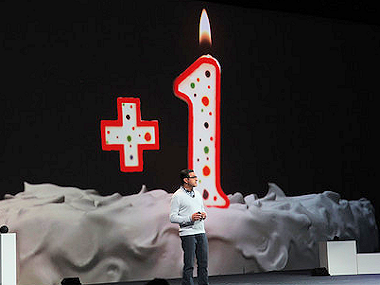
In an effort to expand the reach of its social network, Google on Monday announced that third-party publishers can now embed Google+ posts into their websites.
Simply put: A site like AllThingsD could grab a publicly-made Google+ status update and, with the addition of a snippet of code, display it in a story.
At this point among the major players in social, it's a table stakes move. Twitter has long had embeds available, pitching the feature heavily to news sites and consumer outlets. And now both Facebook - which has made strides to surface more public-facing activity as of late - and Instagram have done the same. Google+ is a natural addition.
It's certainly a sensible move for all three companies, each of which aims for broad consumer recognition and appeal. It's also a trojan horse for potential new user signups if readers click through to the original social site.
Still, part of me wonders if there's a "peak embed" point. That is to say, if users will grow confused at the multiple types of embedded posts, and thereby not be inspired to click through. Or perhaps the different types of embedded posts will run together, and no one network will stand out.
Embeds should be available to publishers beginning today, with instructions on how to make it work found here.
Wednesday, March 25, 2015
Here Is Airbnb's First Television Ad
The peer-to-peer accommodation marketplace Airbnb ran its first television advertisement this week, and it wasn't your average 30-second spot. Instead, it was an allegorical short film that aired on the Sundance Channel Thursday night. How much did that slot cost? Nothing.
"Hollywood & Vines" is a four-and-a-half-minute piece about the life and aspirations of paper airplanes, composed entirely of six-second clips made with the Twitter-owned mobile app Vine.
Each short, postage-stamp-sized scene was submitted in response to an individual tweet from Airbnb, like "A paper airplane falls straight down onto a sidewalk. 2 seconds later a hand carries the plane away," or, "A piece of paper is thrown into a spinning world with other paper products. Darkness!" The company and its partners Mullen SF and B-Reel Productions got more than 750 submissions.
"It's an initiative to bring our global community together to create something meaningful and relevant to Airbnb's brand," said Airbnb spokeswoman Emily Joffrion, who added that the company is planning a set of accompanying events in Los Angeles. "The plot is about learning your place in the world through travel experiences."
Joffrion said Airbnb pitched the film to Sundance, and the channel understood it as more of a creative effort than an ad.
The final result is more than a little quirky, and it's definitely not an in-your-face advertisement for Airbnb. At all:
Thursday, February 19, 2015
More Tech IPOs: Criteo Files, and Rocket Fuel Is Ready to Start Trading Friday
Correction: A previous version of this story incorrectly reported that video ad startup YuMe was trading below its $9 IPO price; YUME shares climbed back above $9 last week and closed today at $11.

Here's another tech company headed for the public markets: French advertising startup Criteo has filed its public IPO documents with the Securities and Exchange Commission, which means the company could be trading in less than a month.
Criteo's latest funding round, completed a year ago, valued the company at $800 million.
Like Twitter - and just about every other company that has gone public this year - Criteo filed its initial documents with the SEC in private earlier this year, using cover provided by the 2012 Jumpstart Our Business Startups (JOBS) Act.
But, unlike Twitter, the timing of Criteo's filing isn't surprising at all, since the ad-tech world has been gabbing about it for months.
Criteo is a retargeting company, which means it helps e-commerce companies track prospects online and show them display ads. Last year, it made a profit of $1 million on sales of $354 million; in the first six months of this year, it lost $6.4 million on sales of $252.7 million.
More than half of Criteo's top-line dollars go back out the door via traffic-acquisition costs. It spent $205 million on TAC last year, and another $152 million in the first half of 2013.
Criteo, which is based in Paris, wants to list its American Depositary Shares on the Nasdaq under the "CRTO" ticker.
Criteo's filing follows disappointing public debuts for ad-tech startups this year. Marin Software and Tremor Media are trading below their IPO prices, and the general climate for ad-tech stocks has been lousy enough that Adap.TV chose to sell to AOL instead of following through on its IPO plans.
But now the conventional wisdom is that investors are once again willing to look at companies that combine technology and advertising, at least in some cases - see Facebook's triumphant return.
We should get a better sense of investors' appetite for ad tech at the end of this week, when Rocket Fuel, which helps advertisers buy "programmatic" inventory, is supposed to go public. People familiar with the company's plans said it expects to price its shares on Thursday, and head to the Nasdaq Friday morning.
(Image courtesy of Shutterstock/Everett Collection)
Correction: A previous version of this story incorrectly reported that video ad startup YuMe was trading below its $9 IPO price; YUME shares climbed back above $9 last week and closed today at $11.
Wednesday, February 18, 2015
How to Launch a New Photo App: Wait for iOS 7 Launch, Try to Get Featured. Then Hope.

Another new photo-sharing app? In 2013? Really?
Yup, really. But say this for the team behind Memoir, which is launching today: While sharing photos is a component of what their app does, it's not solely a photo-sharing app. It's more of a photo-storage and filing service, with ambitions to move someday beyond photos into other personal data.
Which is good, because it sure seems like the photo-sharing app space is full up, though people are still trying to prove otherwise.
Memoir was co-founded by Lee Hoffman and Angela Kim, and is a pivot out of Veri, a TechStars education startup they launched in 2011. They raised $1.2 million for that project from backers including BetaWorks and SV Angel, and used much of that to move into Memoir; they're also finishing a new funding round.
You can get a sense of what they're trying to do with Memoir in the video below, but if you want a very short sentence, it would be: TimeHop mashed up with Photo Stream.
More sentences: Memoir checks the metadata for pictures you have on your phone, plus those you upload to Facebook and other services (if you let it), and organizes them by date and location; it will also try to figure out who you were with when you took the photo. Then it stores all the images on its servers, and lets you access them whenever you want; it assumes your photos are private, and will only share them with friends if you ask.
The service is free now, and the company hopes to introduce a freemium model that will give you access to goodies like higher-resolution images, etc. One day, Hoffman and Kim can see Memoir storing and filing things that aren't photos.
For now, they're just hoping to pick up some momentum from today's Apple's iOS 7 launch.
They've held the launch of their app until this afternoon, with Apple's encouragement, in the hope that they get featured in Apple's App Store. There's no guarantee that they'll get that attention, and even if they do, a feature slot at the App Store is no guarantee of success.
But it sure would be nice to show up today, when lots of you are going to be spending lots of time there.
Introducing Memoir from Memoir on Vimeo.
Saturday, February 14, 2015
Sunday, February 8, 2015
Wednesday, January 21, 2015
Twitter For Android Gets Push Notifications, Multiple Accounts

Twitter just released a new version of its client app for Android smartphones, introducing a couple new features including support for push notifications.
If you want push alerts, you'll need to set your account up for automatic refresh mode, after which you'll be informed of any tweets headed your way by means of the Android notification bar. This has been a long time coming, and really feels like the stand-out feature of this release.
Another useful new feature, though not everyone will take advantage of it, is support for multiple Twitter accounts without having to log in and out. If you've got a personal account alongside one for your professional life, this could be pretty useful.
Though Twitter didn't feel the need to elaborate much on them, this release also reportedly includes a whole bunch of other little improvements, along with the expected collection of bugfixes. One thing we do know you can look for are some changes to update the available home screen widgets.
Twitter 2.1.0 is available for download in the Android Market now.

Wednesday, December 31, 2014
Former Twitter, Facebook Product Pro Josh Elman Becomes Partner at Greylock

Venture capital firm Greylock Partners announced on Wednesday that Josh Elman, a Silicon Valley veteran of mainstream consumer tech companies, has been promoted to become the firm's newest partner.
Elman joined Greylock as a principal almost two years ago, after his time at Twitter as a product manager, where he lead the growth team for the microblogging service.
Before that, he was a product manager working on Facebook Platform, leading the launch of Facebook Connect, the product used on many, many websites today (including this one). And before that, he spent time in product management positions at both Zazzle and LinkedIn.
"I believe in investing in stuff that I know," Elman said in an interview. "That means I'll likely be looking at consumer tech, with a focus on looking for companies that find the best ways to connect people with one another."
He has worked with local social network Nextdoor, for example, on growth, product and strategy decisions.
"I think the fact that we're still so early in the days of mobile - with the rise of smartphones and tablets - we're just at the beginning of how we do that connecting," Elman said.
Elman will be based in Greylock's Menlo Park, Calif., office.
Thursday, December 4, 2014
Twitter is going to start keeping tabs on the apps you have installed on your device

Twitter is one of the largest social networking entities on the internet, and apparently the company wants to know which apps you’re using on your devices.
To learn the apps that its users are using, Twitter is going to start shopping on them right on your device, according to a new blog post the company recently published. The announcement details how, from this point on, Twitter will use its mobile applications to essentially snoop other apps on a device. This data will apparently allow Twitter to better provide “tailored content,” within your stream:
“To help build a more personal Twitter experience for you, we are collecting and occasionally updating the list of apps installed on your mobile device so we can deliver tailored content that you might be interested in. If you're not interested in a tailored experience you can adjust your preferences at any time (read below). Additionally, if you have previously opted out of interest-based ads by turning on "Limit Ad Tracking" on your iOS device or by adjusting your Android device settings to "Opt out of interest-based ads," we will not collect your apps unless you adjust your device settings.“
It should also be noted that this new tactic is actually opt-out. What that means is that Twitter is going to begin collecting this information from user’s devices automatically. If a user does not want this data collected, they will have to go out of their way to opt-out.
According to a report published by Re/code following the announcement, Twitter’s tentacles into other apps is only at surface level. Meaning, while this data collection will be able to showcase to Twitter that a user has, say, Rdio installed on their device, the company will not be able to learn what songs the user listens to. So, Twitter will be able to learn the names of apps on a specific device, but not, exactly, what that app is being used for.
“That does not mean, however, that developers can gather data from within those apps, such as how often a person uses them, or what information a person has shared. Developers can only collect the app name. Twitter, for example, may know a user has Spotify, but it can't know which songs the person is listening to.“
The iOS app update is heading out to users now. If you wish to opt-out, or learn more about this data collection, simply head through the Twitter source link below.
[via Re/code; Twitter]
Monday, November 24, 2014
Sunday, November 23, 2014
Faster, iPhone
I can't believe Apple isn't moving faster to create a larger iPhone screen. Bring back Steve Jobs!
- Donald Trump, via Twitter. Note Dan Amira's RT asking "Who's gonna tell him?"
Tuesday, November 11, 2014
Twitter to Add Parental Controls

Twitter has added a way to flag links within tweets as "possibly sensitive." The company announced late Thursday that there is a new field in the Twitter streaming API that will show up whenever a tweet contains a link, giving Twitter users the option to be warned before they click links that might be too sensitive for the workplace, or for tender ears and eyes.
The new feature is not functional yet, but Twitter was informing developers that it was just added and is now in the testing phase. According to Twitter representative Taylor Singletary, "In the future, we'll have a family of additional API methods & fields for handling end-user 'media settings' and possibly sensitive content."
According to Gizmodo, Twitter reps say the company doesn't intend to censor material. But according to Twitter's media policy document, the company will "remove media that might be considered sensitive such as nudity, violence, or medical procedures."
In the announcement, Singletary encouraged those who were curious about how this capability would ultimately be used to read that media policy document.
To us, this seems like a feature that's long overdue, giving users the ability to control the kind of content they or their children are exposed to, letting them use Twitter without fear of being unpleasantly surprised when they click on an inappropriate link.
Saturday, September 20, 2014
From TWTR to THEG -- Penny Stock Changes Ticker After Twitter Confusion
Sometimes, stories that seem too funny to be true are, in fact, true.
I'm speaking of last week's confusion with Tweeter Home Entertainment Group's stock listing.
After Twitter announced in its S-1 filing last week that it would trade under the symbol TWTR, Tweeter's stock - which is listed as TWTRQ - shot up more than 2,000 percent. (A "Q" affixed to the end usually signifies that the company is in bankruptcy proceedings.)
Confused buyers went so crazy over Tweeter's stock that the Financial Industry Regulatory Authority had to step in and place a temporary halt on the shares.
FINRA wants to clear up the confusion. Effective as of Tuesday morning, Tweeter's new ticker symbol will change to THEGQ, FINRA decided, in order to avoid any "further confusion," according to a filing on the FINRA website.
"FINRA believed that trading in the TWTRQ security demonstrated a widespread misunderstanding related to the possible initial public offering of an unrelated security," the agency wrote.
Probably a good idea, considering the hype for Twitter's forthcoming initial public offering. The company - which has yet to state an exchange or a listing date - is seeing high-enough interest that financial analyst Robert Peck, with SunTrust Robinson Humphrey, has rated the stock a "buy," with a price target of $50 by the end of next year.
As for Tweeter? Shares were trading at $0.0121 on Tuesday morning, down 76 percent from the previous day's close.
Wednesday, September 17, 2014
Tablet-Optimized Twitter Android App Now Available, Limited at First to Samsung Devices
Today, Twitter launched a new version of its mobile app optimized specifically for Android tablets. Twitter for Android Tablets now takes full advantage of a tablet's larger screen to display tweets, conversations and more in full landscape view. The app will only be available for Samsung devices at first, specifically the Samsung Galaxy Note 10.1 2014 Edition. Support for other Samsung tablets will come soon, and the app will be available to other Android tablets by the end of the year.
Wednesday, August 13, 2014
Bilton Book: Twitter's Dick Costolo Was Fired (And Rehired) in 2010

Twitter's founding tale keeps getting more and more complicated.
Twitter CEO Dick Costolo was briefly fired from the company by an adviser to the board in 2010, according to a new book detailing the early, tumultuous days of the microblogging service. The news was unearthed in an article from USA Today on Saturday evening.
The firing came during a trying period for the company, according to the book "Hatching Twitter: A True Story of Money, Power, Friendship, and Betrayal," written by New York Times columnist and reporter Nick Bilton. The board was unsatisfied with the performance of then-CEO Evan Williams, a fact that co-founder Jack Dorsey used to leverage the board into finding a new candidate for the company's chief executive.
As discussions with Williams were coming to a head during a particularly tense meeting in 2010, Twitter board adviser and legendary Silicon Valley figure Bill Campbell decided that Costolo - who was then the company's chief operating officer - should be fired. The rationale, sources said, was that Williams felt Costolo's presence at the company could complicate the search for a new CEO candidate.
According to the book, Campbell "slapped his hand down on the boardroom table," walked downstairs into Costolo's office and fired him on the spot. Costolo, who first thought Campbell was joking, was told to send an email to Twitter's lawyers to negotiate the terms of his severance package.
Twitter declined to comment on the story.
The board quickly reversed its decision shortly after Costolo sent an email asking about the terms of his departure. According to sources familiar with the matter, Costolo's termination was a temporary lapse in the board's judgement, and Costolo never actually stopped working for the company. By early October, Costolo was named CEO of the company.
But the episode further underscores the serious dysfunction that existed inside of the company at its highest levels, even as Twitter continued to grow at a rapid clip, pervading the fabric of the Internet and media pop culture. It is an image of a company in crisis, one that the Twitter of today desperately wants to escape as it slowly makes its way toward an initial public offering.
The mishap is not an isolated one in Twitter history. Among other embarrassing details, Bilton's book describes squabbles and betrayal between Dorsey and Williams, and the early expulsion of little-known Twitter co-founder Noah Glass.
The book - in all its gory detail - will hit store shelves on Nov. 5.
Monday, August 11, 2014
Viral Video: Thankfully, "Boy Dance Party" Is Not About the Twitter Board
Excuse me, but this hysterical video from last week's "Saturday Night Live" is still making me laugh, even after many watches.
Perhaps it is Bruce Willis and a disco ball, maybe it's the shake sack. In any case, "Boy Dance Party" is destined to be a classic of some sort.
Enjoy:
Friday, August 1, 2014
Pinterest Now Tracks Everybody by Default, but You Can Opt Out
Pinterest will now compile profiles of people who visit sites that contain Pinterest buttons, so their social bookmarking experience can be automatically personalized around interests that correspond to those sites.

This will happen both for people who are currently logged in to the Pinterest website, and for people who have never even joined Pinterest, via anonymized tracking.
"So, if you're planning a party and have gone to lots of party sites recently, we'll try to suggest boards to make your event a hit," Pinterest software engineer Ke Chen explained in a blog post.
"Pin It" buttons and other Pinterest widgets are used on just about every page of major sites, including Amazon, eBay, Nordstrom, REI and Bon Appetit.
Their original purpose was so that that shoppers and other users could easily save items they come across to their Pinterest boards. Since Pinterest sends lots of traffic back to the sites, the buttons are all over the place.
People who want to opt out of Pinterest tracking can enable "Do Not Track" on their browser, change their account settings, or tell Pinterest not to use that data when they sign up.
Pinterest announced the initiative today by emphasizing its support for Do Not Track, a privacy initiative that has had trouble getting off the ground because people can't agree how to implement it, and tracking users is a key ingredient for personalizing services and targeting advertising. As an emerging Internet giant, Pinterest's endorsement for the standard is important.
However, the more notable aspect of today's news doesn't seem to be Do Not Track - it's that Pinterest is tracking people who don't even use the service.
That's because Pinterest wants to provide a good experience for new users the first time they visit, said company spokesperson Malorie Lucich.
"One of our hopes is that, when people join Pinterest, we'll be able to suggest better content to them, so they have a good new-user experience (and see stuff that interests them)," she said. "As part of the sign-up process, they can tell us not to use that type of data. (There is a clear check-box.)"
Data collected about users who are logged out of Pinterest will be anonymized, she said.
Lucich explained, "We think the websites you visit are a good indicator of your interests (and Pinterest is all about your interests). So as people visit sites with the Pin It button (or other Pinterest widgets), we can use that information (if they're interested) to recommend better boards to follow."
She compared the Pinterest feature to one that Twitter launched in 2012, which suggests accounts for new users to follow.
The Twitter suggestions are said to be based on monitoring people who visit sites with Twitter widgets on them, to see what accounts they commonly follow. If the new user has also visited one of those sites in the past 10 days, some of those accounts will be suggested.
Both moves are a little creepy when you think about it - some site that you've never even joined is ready and waiting to personalize itself for you, whenever you show up.
That said, this is not uncommon. Tracking cookies are used all over the Web, and few people know or care about them.
Pinterest said it would be adding the features "in the next few weeks."
Monday, June 16, 2014
Twitter's Roadshow Video: No Frills, by Design

Twitter's IPO roadshow presentation was posted to the Web on Friday morning, as the company kicks off its tour to pitch to investment firms around the country.
The most remarkable point: It's completely unremarkable, a stark contrast to an obvious comparison - the highly produced Facebook roadshow video we saw last year.
Twitter's video consists basically of CEO Dick Costolo laying out exactly what makes Twitter tick, and walking investors through the company's ad products and user statistics. CFO Mike Gupta makes an appearance later on, explaining monetization and the company's rapid revenue growth.
But, unlike Facebook's production, Costolo and Gupta appear against a plain, static backdrop, and run through a series of slides to lay out Twitter - basically the template for any other soon-to-be-public company creating a roadshow video. Compare that to the sweeping camera angles, animated graphics and airy soundtrack seen in Facebook's pitch.
Twitter's S-1, too, was plain and understated. It lacked the founder's letter that Facebook's Zuckerberg penned, instead putting much of the focus again on exactly how Twitter works.
Make no mistake: Twitter's no-frills approach is entirely by design. Despite all the heightened attention it has received, Twitter has sought to make this a low-profile IPO process, aiming to steer clear of the massive hype that surrounded Facebook's debut on the Nasdaq exchange. Instead, the idea has been to position itself more in line with a tech company like LinkedIn, which, compared to Facebook, receives far less media attention yet delivers consistently upbeat quarterly financial results.
To be fair to Facebook, Twitter's pitch wasn't entirely without flourishes. The company ran a short video featuring three of Twitter's founders, as well as Costolo, briefly explaining the service's charm. But it was short and sweet - one minute and 40 seconds, to be exact.
Will the IPO itself, set to drop in the first week of November, actually be as low-key as Twitter wants? Like Fortune's Dan Primack, I seriously doubt that will be the case.
But it certainly won't be for lack of effort by Twitter.
Sunday, May 4, 2014
Apple CEO Tim Cook Joins Twitter, Tweets About iPhone Launch
Apple CEO Tim Cook posted his first tweet on Friday after visiting the Palo Alto Apple Store to witness the launch of the new iPhones.

"Visited Retail Stores in Palo Alto today," Cook tweeted. "Seeing so many happy customers reminds us of why we do what we do."
Cook quickly amassed more than 14,000 followers for his @tim_cook account. So far, Cook is following about a dozen accounts, including the Auburn student newspaper, the RFK Center for Justice & Human Rights, CNN host Anderson Cooper, and Apple colleagues Phil Schiller and Eddy Cue.